Stock Management
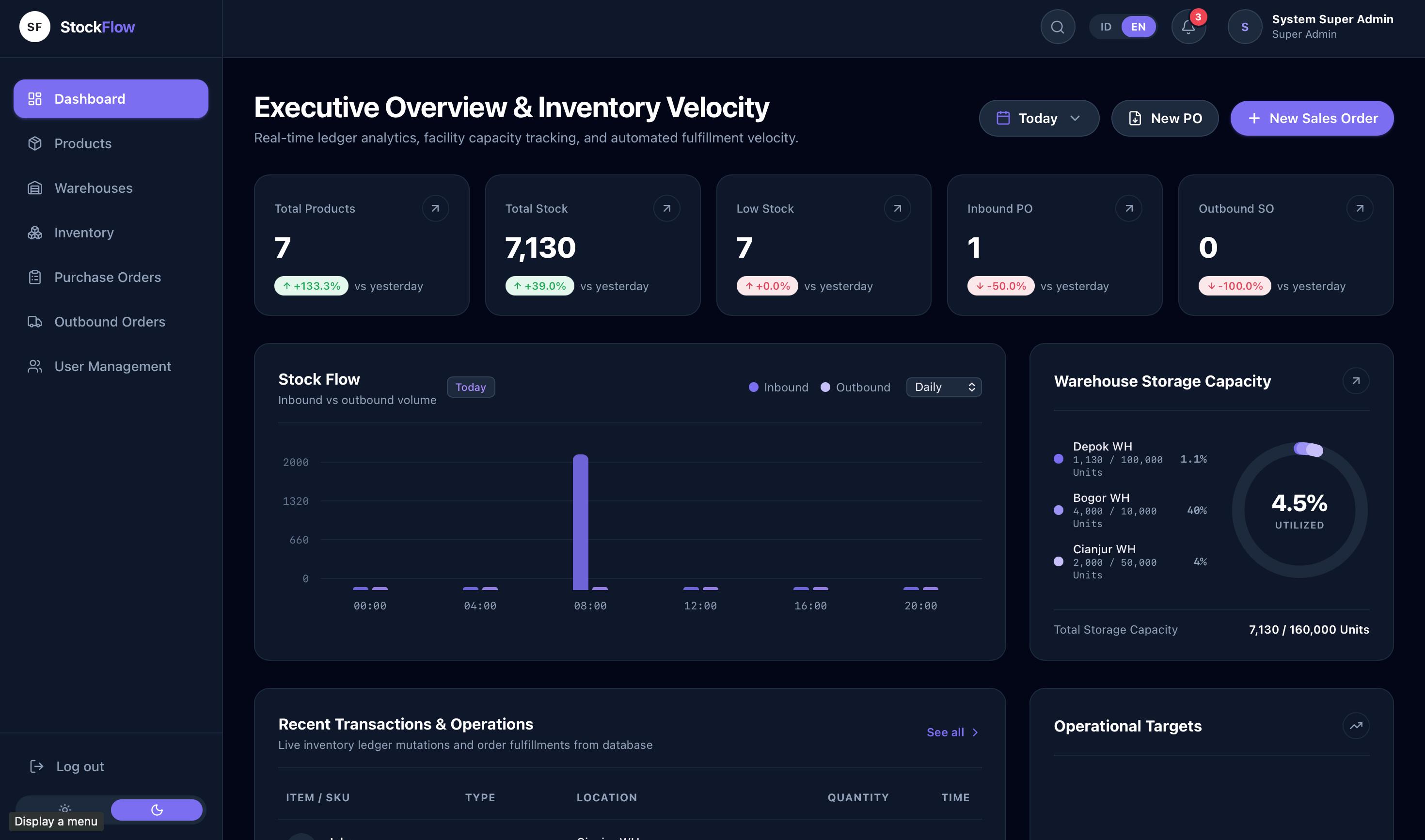
StockFlow — Real-Time Warehouse Management System






Evaluators can register directly on the live site selecting the Warehouse Manager role to access catalog, location hierarchies, inventory movements, PO intake, SO fulfillment, and analytics.
Core Problem
Simple inventory databases often rely on a mutable quantity field updated via raw UPDATE statements. In environments where multiple operators pick, pack, and receive stock simultaneously, this design creates race conditions: overselling, negative stock levels, phantom allocations, and silent bin overflows.
StockFlow enforces three structural constraints:
- Atomic reservations before commit: Sales order confirmation soft-reserves stock against physical balances; if available stock is insufficient, the transaction fails immediately before dispatch.
- Append-only ledger: Physical movements (
IN,OUT,ADJUST,RESERVE,TRANSFER) are logged immutably. Every unit on a shelf traces back to its source purchase order, adjustment, or outbound shipment. - Push-based client synchronization: State changes stream over HTTP Server-Sent Events (SSE). When one user completes an intake or order, other connected sessions update tables and dashboard metrics automatically without periodic polling.
Capabilities
Storage Hierarchy & Bin Quotas
Locations follow a strict 5-tier topology: Warehouse → Zone → Rack → Shelf → Bin. Every storage bin enforces maximum unit capacity. Inbound goods receipts that exceed remaining bin volume are rejected at validation, with available capacity tracked in real time.
Real-Time Sync via Server-Sent Events
A Go broker at /api/v1/events distributes data_changed events over persistent HTTP connections using buffered channels. In testing, 2,000 active SSE connections held under 4 MB of memory (~2 KB per goroutine). The broker sends a 20-second keepalive heartbeat so intermediate proxies don't time the connection out.
Inbound & Outbound State Machines
- Purchase Orders:
Draft → Ordered → Received / Cancelled. Supports supplier linkage, line-item tracking, and multi-bin intake allocation. - Sales Orders:
Draft → Confirmed → Picking → Packing → Shipped → Delivered / Cancelled. Order confirmation soft-reserves inventory; cancellation releases the reservation back to available balance.
Live Metrics & Period Comparison
Tracks five operational KPIs: Total Catalog SKUs, Total Stock on Hand, Low-Stock Alerts, Pending Inbound POs, and Active Outbound Orders. Soft deletes (is_deleted, deleted_at) preserve historical data, so period comparisons stay accurate over time.
Security Hardening (OWASP Top 19 Mitigations)
Built using standard library Go components without third-party middleware bloat:
- Rate limiting: In-memory token bucket (
sync.RWMutex) enforcing 10 attempts/minute on/auth/loginand/auth/register(HTTP 429 withRetry-After), and 120 req/minute on general API endpoints. - OWASP response headers:
X-Frame-Options: DENY,X-Content-Type-Options: nosniff,Content-Security-Policy: default-src 'self'; frame-ancestors 'none';,Strict-Transport-Security, andPermissions-Policy. - CSRF & Origin validation: Strict origin checking for mutating HTTP methods (
POST,PUT,DELETE,PATCH), requiring custom headers (AuthorizationorX-Requested-With: XMLHttpRequest), and rejecting form URL-encoded submissions on JSON endpoints. - NoSQL & ReDoS defense: Search queries in MongoDB repositories (
products,inventory,purchase-orders,sales-orders) are sanitized viaregexp.QuoteMeta(). - DoS payload & socket protection: Maximum request body capped at 2 MB via
http.MaxBytesReader(HTTP 413). Go HTTP server configured with explicit socket deadlines (ReadHeaderTimeout: 5s,IdleTimeout: 60s) to prevent Slowloris resource exhaustion. - Timing-attack resistance: Login runs bcrypt verification against a
dummyHashfor non-existent accounts, so response timing can't reveal whether an account exists.
System Architecture
Operational Workflows
Real-Time Event Synchronization
Role-Based Access Matrix
| Feature / Module | Super Admin | Warehouse Manager | Warehouse Staff |
|---|---|---|---|
| System settings & user provisioning | Full | — | — |
| Warehouse & bin creation | Full | Full | Read only |
| Product catalog & pricing | Full | Full | Read only |
| Stock in / stock out | Full | Full | Full |
| Manual stock adjustments | Full | Full | — |
| PO creation & supplier management | Full | Full | Read only |
| PO goods intake | Full | Full | Full |
| SO creation & approval | Full | Full | Read only |
| Order picking, packing, shipping | Full | Full | Full |
| Dashboard analytics | Full | Full | Summary only |
Benchmarks & Verification
1. Live Production Telemetry (Render + Vercel + MongoDB Atlas)
Measured over public internet HTTPS traffic against the live deployment:
| Metric / Scenario | Test Input / Profile | Production Result |
|---|---|---|
| Read Latency (Public API) | 100 requests across 10 concurrent workers | 100% 200 OK — Min: 40.05ms, Median: 46.77ms, p95: 71.18ms |
| Catalog Query & In-Memory Cache | Authenticated /products query sequence | Cache Miss (Atlas): 50.77ms → Cache Hit: 49.81ms avg |
| Brute-Force Rate Limiter | 15 rapid consecutive /auth/login attempts | Requests 1–10: 401 Unauthorized<br>Requests 11–15: 429 Too Many Requests (Retry-After: 55s) |
| Payload Size Enforcement | 3 MB JSON payload submitted to API | 413 Request Entity Too Large (Cap: 2 MB) |
| CSRF Form POST Rejection | application/x-www-form-urlencoded submission | 415 Unsupported Media Type |
| Cross-Origin Guard | Request with untrusted Origin: https://evil.com | 403 Forbidden |
2. Concurrency & Chaos Test Suite (Engine Isolation)
Executed via backend/cmd/chaos/main.go and go test -race ./...:
| Test Scenario | Load Pattern | Result |
|---|---|---|
| Read Throughput | 2,000 concurrent GET requests | 100% success, 0.85ms avg latency (served from cache) |
| Overselling Contention | 50 concurrent buyers competing for 5 remaining units | Exactly 5 orders confirmed, 45 rejected with HTTP 400. Stock balance never negative. |
| Database Failure Fallback | Simulated MongoDB Atlas network disconnect | Falls back to the in-memory store with no dropped requests; zero process terminations |
| Auth Flooding | 500 forged JWT tokens | 100% rejected with HTTP 401 in <0.2ms per request |
| Race Detector | go test -race ./... across all packages | 0 data races detected |
Tech Stack
- Backend: Go 1.24+, Gin, official MongoDB Go Driver, golang-jwt/jwt/v5, bcrypt.
- Frontend: Next.js 16.3 (App Router, React 19), TypeScript 5.0+, Tailwind CSS v4, Lucide React.
- Infrastructure: Vercel (Edge Network), Render (Container runtime), MongoDB Atlas (M0 Replica Set).
Local Development
Prerequisites
- Go 1.24+
- Node.js 20.x+ and npm
- MongoDB instance (or set
USE_IN_MEMORY_DB=trueto run without MongoDB)
1. Clone
git clone https://github.com/RPriago/stockFlow.git
cd stockFlow
2. Backend Setup
cd backend
cp .env.example .envPORT=8080
MONGO_URI=your_mongodb_connection_string
DB_NAME=stockflow
JWT_SECRET=your_super_secret_jwt_key_min_32_chars
USE_IN_MEMORY_DB=false
CORS_ORIGIN=https://stock-flow-brown.vercel.appgo run cmd/api/main.go3. Frontend Setup
cd frontend
cp .env.local.example .env.localNEXT_PUBLIC_API_URL=https://stockflow-backend-iml2.onrender.com/api/v1npm install
npm run devLicense
MIT — see LICENSE.